Pattern Digitising vs Pattern Making: Where the Boundary Really Is in Fashion Product Development
In B2B fashion production, confusion often arises around the boundary between drafting, pattern making, and pattern digitising services. These terms are frequently used interchangeably, yet they describe distinct technical phases within fashion product development. When the distinctions blur, expectations shift, responsibilities overlap, and production risk increases.
For decision makers managing development pipelines, understanding where pattern making ends and pattern digitising services begin is not semantic detail. It is structural knowledge. The boundary determines workflow clarity, file integrity, grading logic, and ultimately manufacturing stability.
This article examines where that boundary truly lies, why it matters in fashion product development, and how misalignment between these stages can compromise production readiness.
Drafting and Pattern Making: Constructing the Physical Logic
Pattern making begins as a structural translation of design intent into physical geometry. Whether developed through flat drafting or draping, the objective is to construct a base pattern that resolves silhouette, proportion, and construction logic in a single reference size.
Drafting establishes seam lines, balance points, grain orientation, and shaping distribution. At this stage, decisions are tactile and visual. The pattern exists as paper or card components. It is evaluated through toile sampling and iterative adjustment. The output is a corrected base pattern that fits and behaves as intended.
However, drafting alone does not guarantee scalability. A pattern that performs well in one size under controlled sampling conditions may not withstand grading, digitisation, or manufacturing interpretation. The physical accuracy of the base does not automatically translate into systemic stability.
Within fashion product development, this is the first boundary: drafting defines form; it does not define system behaviour.
What Pattern Digitising Services Actually Do
Pattern digitising services convert physical patterns into structured digital files. At surface level, this appears to be a technical transcription process. In practice, it is an architectural translation.
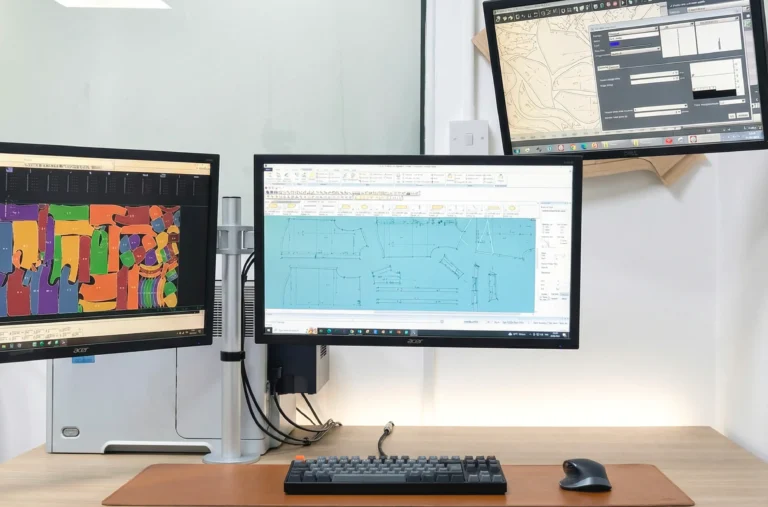
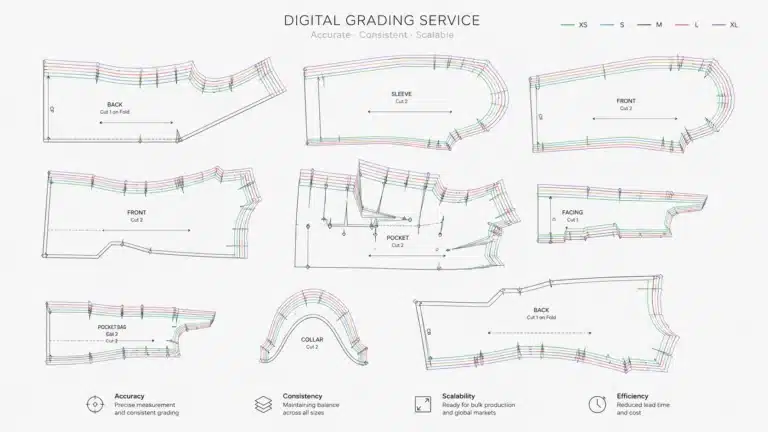
Using systems such as Gerber AccuMark, patterns are recreated within CAD environments where seam allowances, notches, drill holes, grading points, and annotations must be defined with precision. Digital files such as DXF or AAMA formats are not visual replicas; they are instruction systems for downstream processes including grading, marker making, and manufacturing integration.
This is where pattern digitising services move beyond scanning. They require interpretation. If the base pattern contains inconsistencies, unclear notations, or ambiguous construction logic, digitisation exposes those weaknesses. The digital environment enforces precision that paper patterns can conceal.
In fashion product development, digitisation formalises geometry into data. It stabilises pattern logic into a format that production teams can reliably use. The boundary here is critical: digitising does not redesign a garment, but it may reveal structural flaws in the original drafting.
The Overlooked Middle Layer: Technical Development
Between drafting and pattern digitising services lies a less visible but decisive layer: technical development.
Technical development addresses questions such as:
Will this pattern maintain proportional integrity when graded?
Are seam tolerances appropriate for factory machinery?
Do internal references align with construction order?
Is the pattern compatible with overseas manufacturing standards?
This stage often includes amendments, correction of balance discrepancies, seam optimisation, and grading logic planning before full digital rollout. It is the bridge between creative pattern making and scalable system execution.
In fashion product development, failing to distinguish this layer leads to premature digitisation. Brands may assume that once a pattern fits in base size, it is ready for digital conversion. When grading issues or production misinterpretations arise, responsibility becomes unclear. Was the issue in drafting, digitising, or technical preparation?
Clear boundary management prevents this ambiguity.
Why the Boundary Matters in Production
In B2B manufacturing environments, digital patterns are operational assets. They inform marker efficiency, material consumption, cutting precision, and quality control consistency.
If pattern digitising services are performed without confirming technical readiness, downstream consequences appear quickly:
Grading may distort shaping.
Markers may misinterpret seam logic.
Factories may apply construction assumptions not aligned with the intended structure.
The result is not always visible in samples. It often appears at scale.
Within fashion product development, the boundary between drafting and pattern digitising services defines accountability. Drafting resolves design intent. Technical development resolves structural logic. Digitisation encodes that logic into executable data.
When those responsibilities are conflated, production teams compensate reactively. That compensation increases cost and timeline pressure.
Misconceptions That Blur the Boundary
Several misconceptions commonly distort the understanding of pattern digitising services in B2B contexts.
The first is the assumption that digitising is purely administrative. In reality, digital reconstruction requires technical literacy. Incorrect grading points or seam classifications can alter garment behaviour across sizes.
The second misconception is that digital files correct flawed patterns. They do not. Digitisation formalises what already exists. If imbalance or misalignment is embedded in the base pattern, CAD systems will replicate it precisely.
The third misconception is that fashion product development is linear. In practice, the stages overlap, but they are not interchangeable. Drafting informs digitisation. Digitisation does not replace drafting.
Clarifying these misconceptions helps brands define development checkpoints before patterns enter digital systems.
Strategic Implications for B2B Brands
For B2B decision makers, the distinction between drafting and pattern digitising services is a governance issue. It shapes how teams are structured, how timelines are defined, and how risk is allocated.
Brands operating internationally must ensure that digital files are compatible with manufacturing partners across regions. CAD file integrity, grading consistency, and annotation clarity reduce interpretation risk in overseas production environments.
Moreover, separating pattern making from pattern digitising services enables clearer budgeting. Each stage carries distinct expertise and technical responsibility. Collapsing them into a single undefined service often leads to cost escalation when revisions surface late.
In mature fashion product development systems, boundaries are not rigid walls but structured checkpoints. They prevent premature progression into scalable phases before structural validation is complete.
Conclusion: Where the Boundary Really Is
The boundary between pattern making and pattern digitising services is not defined by tools. It is defined by purpose.
Pattern making constructs the garment’s physical logic.
Technical development stabilises that logic for scalability.
Pattern digitising services encode it into production ready data systems.
Understanding this layered progression reduces ambiguity. It clarifies accountability. It protects production timelines.
In B2B fashion product development, precision is cumulative. Each stage must complete its function before the next begins. The boundary matters because once geometry becomes data, correction becomes exponentially more expensive.
Clarifying Development Structure Before Scaling
For brands evaluating their development pipeline, reviewing how drafting transitions into digital systems is often the most overlooked structural audit.
If your workflow moves directly from pattern making into digital conversion without technical validation, exploring our Pattern Digitisation Services and Pattern Amendments and Grading Services pages may clarify where stabilisation should occur before files enter manufacturing environments. You may also find strategic continuity in our related article on pattern cutting and production readiness, which examines how base patterns scale across sizes and teams.
→ Design Consultation
→ Pattern Grading
→ Pattern Digitising
→ Sampling Support