
What Is Pattern Grading? The Essential Size Development Process Before Garment Production

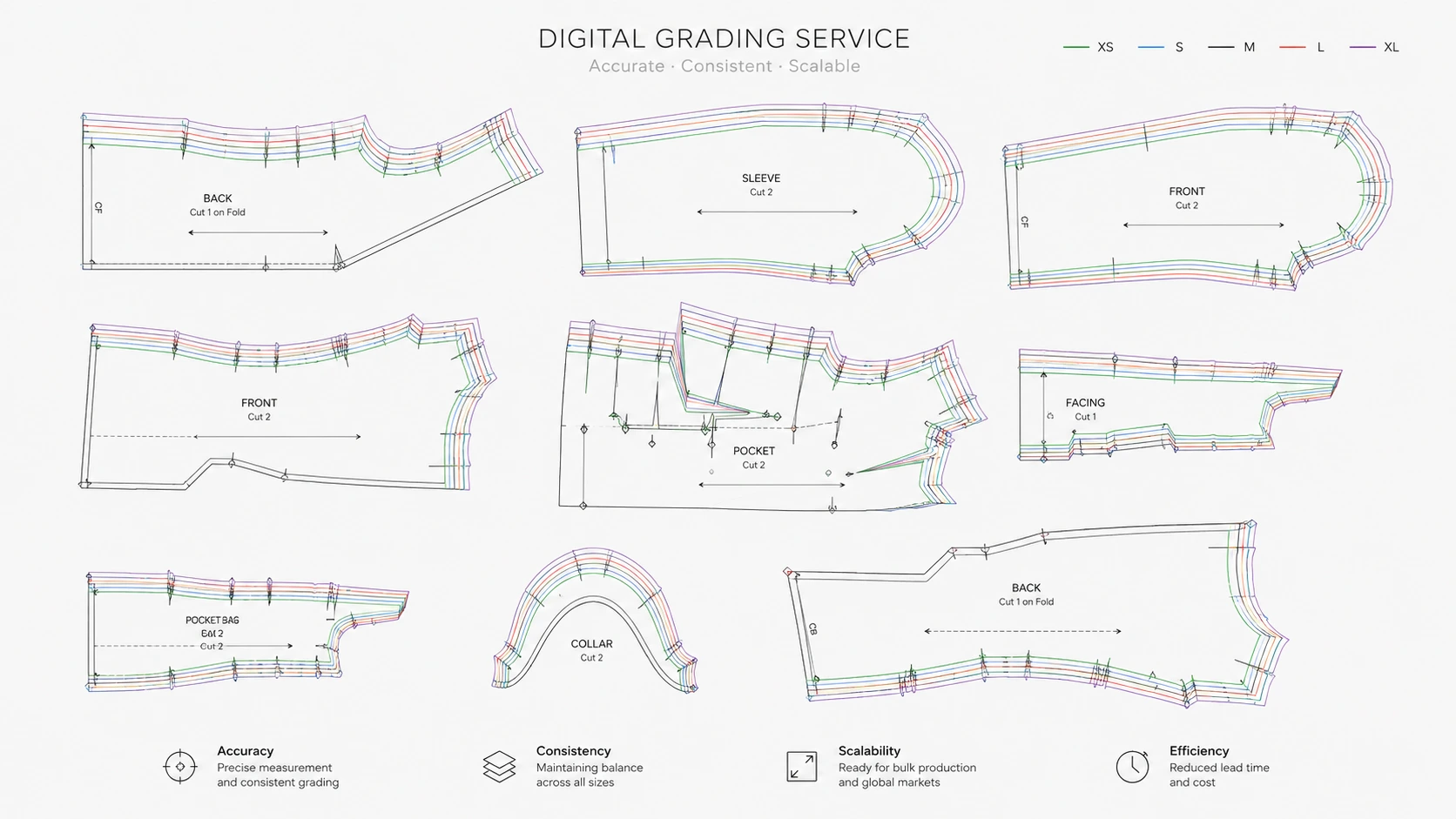
When people think about making clothing, design is often the first thing that comes to mind.
The silhouette, the fabric, the details, the colour, and the overall look of the garment are all important. But when it comes to real clothing production, a good design is only the beginning.
A sample may look great in one size, but that does not automatically mean it is ready to be produced in a full size range.
This is where pattern grading becomes essential.
Pattern grading is the process of taking a base-size pattern and developing it into other sizes. For example, if a sample has been made in a UK 10, grading allows that pattern to be developed into UK 6, UK 8, UK 12, UK 14, UK 16, and beyond.
But pattern grading is not simply making a pattern bigger or smaller.
Good grading keeps the shape, fit, balance, and design intention of the original sample as consistent as possible across different sizes. It is one of the key steps that turns a successful sample into a production-ready size range.
Why Is Pattern Grading Important?
A garment can look beautiful in the sample size, but problems often appear when the same style is made in other sizes.
The shoulder may look wrong.
The armhole may feel uncomfortable.
The waistline may sit in a different place.
The proportions may no longer feel balanced.
These issues often come from the size development stage.
The human body does not grow or reduce evenly in every area. The bust, waist, hip, shoulder, arm, leg, neckline, rise, and garment length all change in different ways. Because of this, each part of the pattern needs to be adjusted carefully.
Good pattern grading helps the fit of the base size continue naturally into the other sizes.
In simple terms, pattern grading is the process of making sure a garment that works well in one size can also work well in the rest of the size range.
Good Grading Builds Size Confidence
Customers expect a brand’s sizing to feel consistent.
If someone buys a UK 12 dress from a brand and it fits well, they are more likely to trust that brand’s UK 12 again in the future. But if one product fits well and another feels completely different, it becomes harder for the customer to know which size to choose.
This is especially important for online fashion brands.
When customers shop online, they cannot try the garment on before buying. They rely on the size guide, product description, photos, and their previous experience with the brand.
Pattern grading plays an important role in building that trust.
A size chart alone is not enough. The actual patterns need to be developed correctly so that each size reflects the intended fit, shape, and balance of the garment.
When grading is done well, the customer is more likely to experience consistency across the collection. This can help improve confidence in the brand and support a smoother buying experience.
Why It Matters for UK and European Clothing Production
For brands planning to produce garments in the UK or Europe, pattern grading is a key part of the production preparation process.
A factory cannot work from a design idea alone.
To produce a garment properly, the factory needs accurate patterns, size specifications, technical details, fabric information, construction notes, and production-ready files.
If a brand wants to produce more than one size, each size needs to be clearly prepared. Without proper grading, there can be confusion during sampling, cutting, sewing, and quality control.
Poor grading can lead to repeated sample corrections, unclear communication with the factory, inconsistent sizing, and delays in production.
On the other hand, when grading is clear and accurate, the production process becomes much more organised. The factory can work from reliable size patterns, and the brand can review size sets and production plans with greater confidence.
Pattern grading is not just a technical task inside the pattern room. It is a practical bridge between the brand, the sample, and the factory.
Can You Just Enlarge the Pattern?
Many people assume that grading means simply enlarging or reducing the original pattern.
But clothing patterns are more complex than that.
Take a jacket, for example. Increasing only the chest measurement will not create a well-balanced larger size. The shoulder width, armhole, sleeve head, sleeve width, body length, lapel position, and button placement all need to work together.
The same applies to trousers.
You cannot simply increase the waist and hip and expect the garment to fit properly. The rise, thigh, knee, hem, curve placement, and overall balance all need to be considered.
A dress, shirt, coat, sportswear garment, or uniform will each require a different grading approach.
The structure of the garment, the fabric, the stretch, the intended fit, and the purpose of the product all affect how the pattern should be graded.
This is why pattern grading is not just a digital resizing process. It requires an understanding of garment construction, body proportions, fit, and production.
When Do You Need Pattern Grading?
Pattern grading is usually done after the base-size sample has been developed and the fit has been approved or is close to approval.
If the base pattern is still changing, it is usually better to resolve the main fit and design issues first. Otherwise, every change made to the base size may need to be repeated across the full size range.
You may need pattern grading when:
- Your sample size is approved and you are ready to create a full size range
- You want to produce sizes such as UK 6 to UK 18 or XS to XL
- You are preparing patterns for a UK or European factory
- You need production-ready size patterns
- You are launching an online collection and want clearer sizing
- Your existing size range feels inconsistent
- You are developing petite, tall, plus-size, or extended sizing
- You need a size set for sampling or production review
The more information you provide, the more accurate the grading process can be.
Useful information usually includes the base pattern, approved sample, target size range, size specification, fabric details, fit comments, and production plan.
How Pattern Grading Supports Production
Good pattern grading can support a brand in several practical ways.
First, it helps maintain the intended fit across different sizes. The design developed in the sample size can be translated more carefully into the rest of the range.
Second, it can reduce unnecessary sample corrections. When the size development is considered properly from the start, the brand is less likely to face avoidable fit problems later.
Third, it helps improve communication with the factory. Clear size patterns and measurements give everyone a more reliable reference point.
Fourth, it supports online sales by helping customers choose their size with more confidence. Consistent sizing makes it easier for customers to understand how a brand fits.
Finally, it adds professionalism to the product development process. Customers may not see the grading work directly, but they can feel the result when they try on the garment.
Good grading is one of the invisible details that can make a product feel more considered, more consistent, and more ready for market.
Do Small Brands Need Pattern Grading?
Yes.
Pattern grading is not only for large fashion companies or mass-production brands. It is also important for small brands, independent designers, start-ups, and first-time collections.
In fact, getting the sizing right early can be especially helpful for a new brand.
When a brand is still building customer trust, inconsistent sizing can quickly become a problem. It can affect customer reviews, returns, stock planning, and future product development.
Even if you are not producing large quantities, it is still useful to establish a clear size structure from the beginning.
A good pattern and a reliable grading system can become part of your brand’s technical foundation. They are not just useful for one product or one season. They can support future collections and help your brand grow with more consistency.
Grade House Pattern Grading Services
Grade House is based in London and provides technical services for brands preparing for garment production.
Our services include pattern cutting, pattern grading, pattern digitising, tech packs, marker making, and other key stages of product development.
We work with womenswear, menswear, childrenswear, sportswear, uniforms, and a range of other garment types. Our pattern grading service helps brands develop their base-size patterns into clear, production-ready size ranges.
At Grade House, pattern grading is not treated as a simple resizing task.
We look at the garment, the fit, the fabric, the construction, and the brand’s intended size range. The aim is to help the original design work as consistently as possible across different sizes.
A good sample is an important starting point.
But a good product needs to work in every size you plan to sell.
Pattern grading is the process that connects the two.
If you are preparing to produce clothing in the UK or Europe, having your patterns properly graded can make the next stages of sampling, production, and factory communication much smoother.
Grade House helps brands move from idea to sample, and from sample to production, with professional pattern grading and garment development support.
Explore Our Technical Development Services
If this perspective resonates with your current fashion product development challenges, you may explore more about our process and services here:
→ Pattern Cutting
→ Pattern Grading
→ Pattern Digitising
→ Sampling Support


