
AI in Fashion Industry: The AI Invasion of Fashion and the Reconfiguration of Design, Development, and Production

Introduction: When Integration Becomes Structural Authority
The AI invasion of fashion did not begin inside factories. It began with visual outcomes.
AI generated sketches, instant trend simulations, and automated mood boards entered creative studios as supportive tools. They appeared optional and contained. Yet what started as assistance is evolving into structural authority.
AI in fashion industry systems is no longer confined to visual experimentation. It is reorganising how decisions are made, how products are validated, and how production risk is controlled. Control is gradually shifting from experience driven workflows toward data informed systems.
This shift is not about speed alone. It is about structural reconfiguration.
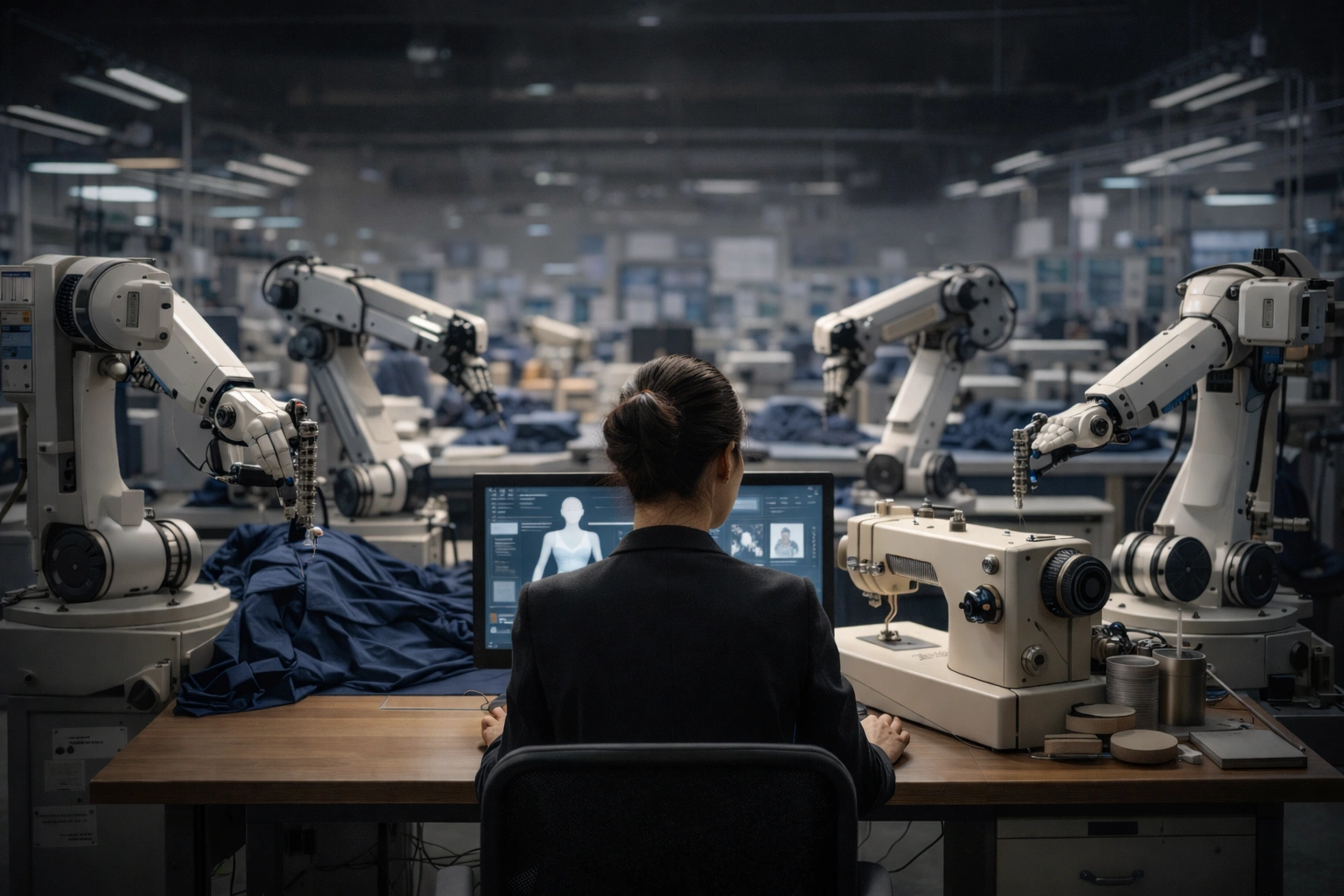
This article examines how AI in fashion industry environments are reshaping design, fashion product development, and garment production at a systemic level.
AI and Fashion Design: Expansion Without Structural Resolution
At the design stage, AI operates as an expansion engine. Generative systems rapidly visualise silhouettes, textile manipulations, colour systems, and cultural references. Exploration that once required weeks can now be executed within hours.
However, acceleration does not equal resolution.
AI generated concepts often lack embedded construction logic. Seam placements may appear refined yet fail under physical stress. Proportions that look balanced in digital renders may distort when translated into drape. Fabric suggestions frequently overlook material behaviour, weight distribution, and production feasibility.
Within professional fashion product development structures, AI expands ideation but does not eliminate interpretation. Designers increasingly function as evaluators and structural editors. Every output must pass two filters. Brand coherence and manufacturability.
AI in fashion industry design environments therefore increases both creative breadth and technical responsibility. Without validation, creative expansion becomes downstream inefficiency.
AI in Fashion Product Development: Compressing Structural Iteration
The development stage is where structural impact becomes measurable.
Fashion product development converts design intent into executable specification. Pattern construction, grading systems, fit analysis, material testing, and technical documentation converge into a unified framework. AI is progressively integrating with digital pattern systems and three dimensional garment simulation platforms.
AI driven systems analyse revision histories, detect geometric distortions in pattern structures, and identify grading inconsistencies before sampling begins. Drape simulation reduces reliance on physical prototypes. Sampling rounds decrease. Decision cycles accelerate.
This compression reshapes development architecture.
AI in fashion industry development does not replace technical teams. It enhances diagnostic foresight. Pattern makers and technical developers gain earlier visibility into instability points. Development shifts from reactive correction toward proactive stabilisation.
Data scope remains decisive. When datasets include body diversity, regional sizing logic, and material variability, automated optimisation in ready to wear becomes realistic. More intuitive sectors such as haute couture may adopt more gradually, yet structural boundaries continue to move as data expands.
AI in Garment Production: Predictive Manufacturing and Control Redistribution
Production is often described in terms of automation. The deeper transformation lies in predictive manufacturing and control redistribution.
AI in garment production integrates large scale data streams to detect patterns invisible to manual supervision. Minor grading inconsistencies, recurring construction failures, and specification ambiguities can be forecast before they multiply into cost overruns.
Predictive manufacturing shifts authority.
Seam stress simulation identifies high tension failure zones prior to bulk cutting. Historical defect analysis reveals systematic weaknesses across facilities. Production managers increasingly operate through predictive dashboards rather than retrospective reports.
Decision latency compresses. Operational control becomes data centric.
However, the effectiveness of AI in fashion industry production environments depends on digital infrastructure. Fragmented supply chains without standardised data collection undermine predictive reliability. Without structural data integrity, AI becomes surface level technology rather than stabilising architecture.
Influence scales with infrastructure maturity.
Structural Advantages and Strategic Risk
When AI aligns across design, development, and production, three structural advantages emerge.
Precision improves through early error detection.
Iteration compresses through simulation.
Scalability strengthens through digital continuity.
For B2B brands managing international manufacturing networks, this alignment converts expansion risk into controlled scaling.
Yet structural risks must be acknowledged.
Homogenisation may weaken differentiation as optimisation datasets converge. Skill dilution may occur if automated validation replaces technical judgement rather than reinforcing it. Platform dependence introduces systemic vulnerability.
Adoption must therefore reinforce internal expertise rather than diminish it.
Long Term Outlook: Structural Governance Over Tool Adoption
AI in fashion industry systems is evolving into infrastructural governance.
Design workflows will remain generative, yet evaluation authority will become increasingly hybrid. Development environments will embed AI assisted diagnostics as standard practice. Production systems will operate through predictive manufacturing logic.
Competitive advantage will belong to organisations that design integration deliberately.
Those who treat AI as acceleration software may gain temporary efficiency. Those who restructure fashion product development around data integrity and cross stage continuity will achieve durable stability.
AI does not eliminate designers, pattern makers, or production managers. It redistributes influence. Designers interpret meaning. Developers translate feasibility. AI predicts variability. Accountability remains human.
The invasion is not replacement. It is structural reconfiguration.
Conclusion: Shape the Structure or Be Shaped by It
AI in fashion industry environments now operates beyond experimentation. It is embedding itself into the structural continuity between design, development, and garment production.
Integrating AI without revisiting workflow architecture produces surface level speed. Integrating it within disciplined systems redistributes control, reduces friction, and stabilises scalability.
The strategic issue is no longer adoption. It is governance.
Predictive capability must align with technical judgement. Organisations that architect integration deliberately will shape the emerging structure. Others will adapt to it.
AI should be understood as part of an integrated fashion product development architecture. When pattern construction, grading frameworks, and sampling systems are structurally aligned, AI amplifies stability. When fragmentation persists, AI amplifies instability.
The decisive variable is not technology.
It is structural alignment.
Strategic Implementation
AI integration produces measurable advantage only when foundational development systems are stable. Digital pattern systems must be structurally coherent. Grading frameworks must maintain cross size consistency. Sampling workflows must operate within controlled technical architecture.
Grade House supports brands at this foundational level. AI in fashion industry transformation is powerful. However, digital acceleration delivers results only when technical architecture is sound.
Explore more about our process and services here:
→ Design Consultation
→ Pattern Grading
→ Pattern Digitising
→ Sampling Support


